






The End of the Impossible Choice: 5 Surprising Ways WhatsApp Coexistence is Changing Business Forever
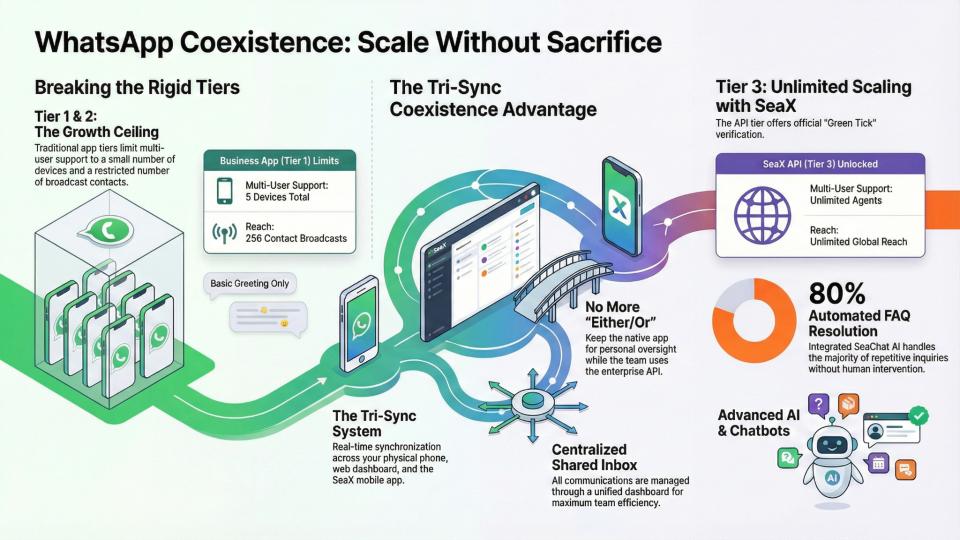
For years, growing businesses faced a frustrating digital stalemate. You could stay on the WhatsApp Business App, enjoying its personal touch and free 1:1 messaging, but you were limited by a single device and manual processes. Or, you could upgrade to the WhatsApp Business Platform (API) to unlock industrial-scale automation and CRM integration—but at a steep cost: you had to delete your mobile app, potentially change your number, and wipe your entire local chat history.
This “Great Messaging Dilemma” forced a choice between being human and being scalable.
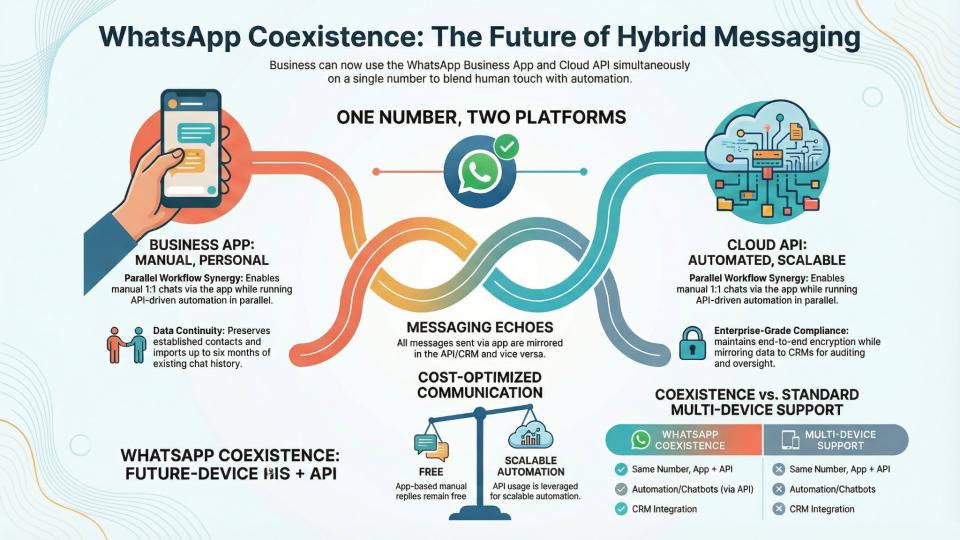
That era is over. Meta’s rollout of WhatsApp Coexistence is a fundamental architectural shift that allows businesses to run both the mobile app and the Cloud API on a single phone number simultaneously. By creating a synchronized “mirroring” layer between your handheld device and the cloud, Meta has effectively deconstructed the phone number into a multi-channel digital identity.
Here are the five most impactful takeaways from this shift and what they mean for your operational strategy.
1. You No Longer Have to Choose Between “Human” and “Hired Bot”
Historically, the API was a “desktop-only” environment, which was a dealbreaker for field-based professionals—like real estate agents showing properties or doctors on clinical rounds—who rely on the native mobile experience. Coexistence introduces Simultaneous Use. Your team can keep the app on their smartphones for high-touch, personal 1:1 conversations, while your CRM or AI chatbot handles routine inquiries, shipping updates, and lead qualification in the background.
This creates a “human-in-the-loop” workflow. If a chatbot qualifies a lead but the customer asks a complex, sensitive question, a human agent can jump in natively from the app to provide a personalized response without the customer ever sensing a platform shift.
Human + Automation, Together: Handle high-touch chats personally via phone and scale routine messages with automation from a centralized platform.
2. The “Zero-Disruption” Migration (History Stays Put)
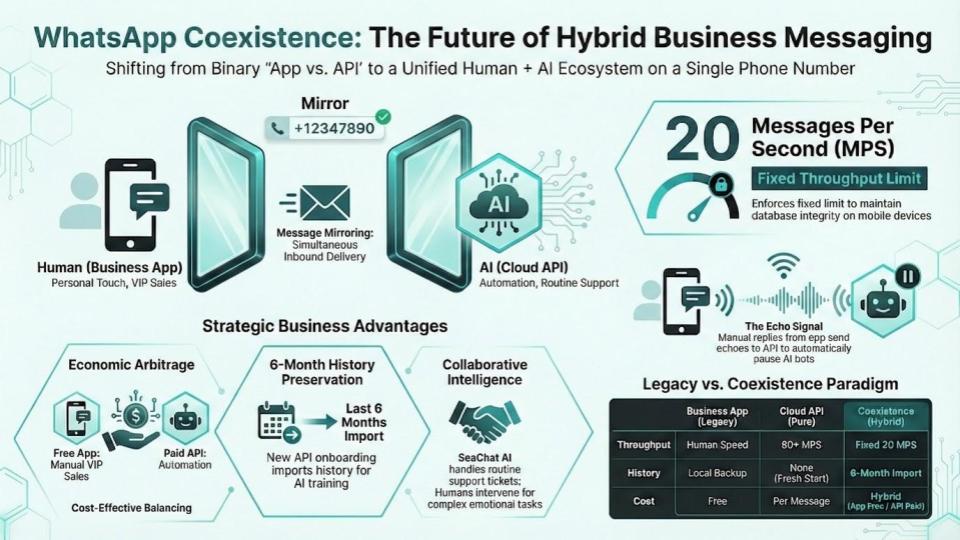
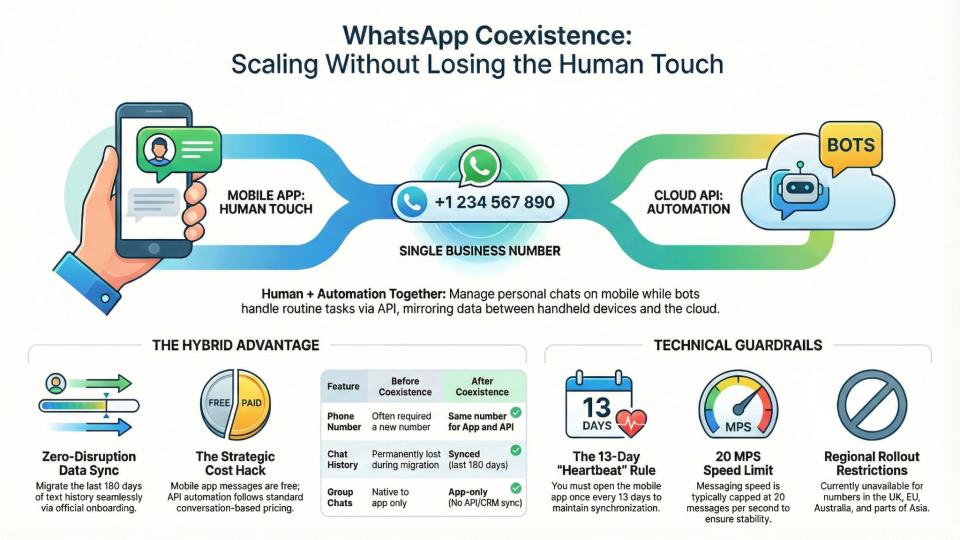
The primary fear for any business owner is “data erasure.” Before Coexistence, migrating to the API meant losing years of customer context. Now, Meta allows for a 180-day chat history sync. When you link your app to the Cloud API via the official Embedded Signup flow, the system can initiate a background migration of your last six months of text messages and existing contacts.
However, there is a technical urgency to this process: the solution provider must trigger the data sync via the official endpoint within a 24-hour window after onboarding finishes. Furthermore, while six months of text context are preserved, media files older than 14 days are not synchronized.
| Feature | Before Coexistence | After Coexistence |
|---|---|---|
| Phone Number | Often required a new number | Same number for App and API |
| Chat History | Permanently lost during migration | Synced (last 180 days) |
| Onboarding | High risk; complex cutover | Seamless; QR-code based |
| Group Chats | Native to app only | App-only (No API/CRM sync) |
3. The Strategic “Free vs. Paid” Cost Hack
Coexistence introduces a hybrid economic model that savvy businesses use to protect their margins. Under this architecture, the billing for a single number is split based on the “Source of Truth”:
- App-Side Messaging: Any message sent manually by an employee from the mobile device remains 100% free.
- API-Side Messaging: Conversations initiated via the Cloud API (like automated templates, marketing broadcasts, or chatbot replies) follow Meta’s standard conversation-based pricing.
This allows you to “split” your costs. You can use the paid API for high-scale marketing campaigns to reach thousands of customers, and then have your staff handle the resulting 1:1 support replies or sales follow-ups for free on their phones. It provides enterprise power with the cost-efficiency of a small business tool.
4. The “Heartbeat” Rule and the 20 MPS Speed Limit
While Coexistence offers massive flexibility, it operates within strict technical guardrails to prevent the mobile app from crashing during state updates.
Mandatory: The “Active App” Requirement
The primary mobile device must remain the “anchor” of the account. To maintain the synchronization link, you must open the WhatsApp Business App at least once every 13 days. If this “heartbeat” is missed, the Meta server may assume the connection is stale and disconnect the API.
Furthermore, Coexistence accounts operate under a fixed throughput ceiling. While standalone API accounts can scale to hundreds of messages per second, Coexistence numbers are typically capped at 20 messages per second (MPS), and in many regional implementations, this is fixed as low as 5 MPS. This limit exists to protect the stability of the sync; pushing thousands of messages per second would overwhelm the mobile app’s local database as it attempts to “echo” the cloud activity.
5. The Survival of the Fittest (Feature Trade-offs)
To maintain a centralized audit trail and ensure compliance, certain mobile features are sacrificed when Coexistence is enabled. These are intentional restrictions designed to ensure that every promise made to a customer remains mirrored in your CRM.
What you give up to scale:
- Companion Device Unlinking: On day one of onboarding, all existing linked devices (WhatsApp Web/Desktop) will be automatically disconnected and must be re-linked manually.
- App-Only Features: Group Chats and Voice/Video calls remain functional in the app but do not mirror to the API or CRM.
- Broadcast Lists: These are disabled or become read-only in the app; mass-messaging is moved to the API “Campaigns” feature.
- Disappearing & View-Once Media: Both are disabled to prevent gaps in the central record.
- Message Editing: You can no longer edit or revoke sent messages from the app side, ensuring the CRM record matches the customer’s view.
- Lite API Exclusion: Numbers onboarded via Coexistence are generally ineligible for Meta’s “Lite API” marketing offerings.
The Regional Catch: The “Not-So-Global” Rollout
Despite its strategic value, Coexistence is currently in a phased rollout. As of September 13, 2025, several major regions remain unsupported for the Coexistence onboarding flow. Businesses using phone numbers with country codes from the following areas may currently be ineligible:
- Europe & UK: United Kingdom, European Union (EU), and European Economic Area (EEA).
- Global: Australia, Japan, Nigeria, Philippines, Russia, South Korea, South Africa, and Turkey.
If your business operates with a number from these regions, you will likely still need to choose between a standalone App or a standalone API until Meta expands support.
Conclusion: A Hybrid Future
WhatsApp Coexistence represents the end of the “Impossible Choice.” It allows businesses to grow organically, evolving from a solo mobile user into a sophisticated, multi-agent operation without the pain of data loss or number changes.
By blending the intuitive warmth of the mobile app with the systemic power of the Cloud API, Meta has provided a low-risk pathway to digital transformation. Now that the technical barrier is gone, the real question remains: is your team ready to handle the scale of automated messaging, or will you miss the human connection that built your business in the first place?
Ready to modernize your strategy?