





Comparative Analysis of WhatsApp Business Solutions (2025-2026)
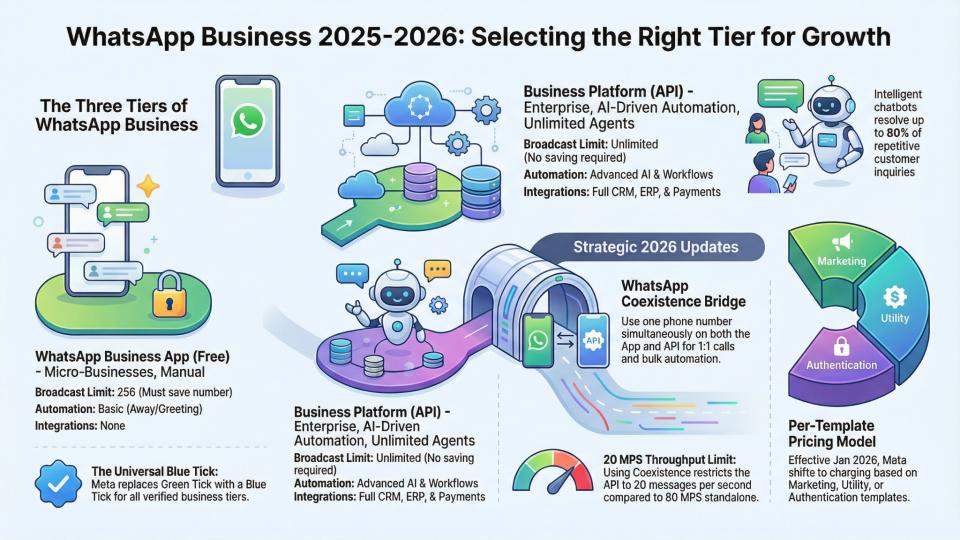
The WhatsApp Business ecosystem is categorized into three distinct tiers: the WhatsApp Business App, WhatsApp Business Premium, and the WhatsApp Business Platform (API/Cloud API).
The fundamental divide lies between manual, small-scale operations and automated, enterprise-level communication. The WhatsApp Business App remains a free, entry-level tool for micro-businesses, limited by manual processes and single-user constraints. WhatsApp Business Premium acts as a middle-tier subscription providing basic team collaboration tools. In contrast, the WhatsApp Business Platform (API) is the enterprise standard, designed for high-volume, programmatic messaging, deep CRM integration, and AI-driven automation.
Critical updates for 2026 include Meta’s shift to a per-template-message pricing model and the introduction of WhatsApp Coexistence, which allows businesses to bridge the gap between the App and the API using a single phone number.
1. WhatsApp Business App: The Entry-Level Solution
The WhatsApp Business App is a free mobile application designed for individuals and small businesses (SMBs) with low message volumes.
Core Features
- Business Profile: Displays name, address, website, and opening hours.
- Product Catalog: A mobile-storefront to showcase products or services.
- Basic Automation: Includes greeting messages, away messages, and “quick replies” for FAQs.
- Labels: Visual tags to organize and categorize chats.
Critical Limitations
- Scalability: Limited to one primary phone and up to four linked devices.
- Broadcast Constraints: Messages can only be sent to 256 contacts at once, and they are only delivered if the recipient has the business number saved in their contacts.
- Lack of Integration: No native ability to connect with CRMs (e.g., Salesforce, HubSpot) or ERP systems.
- Manual Operation: Does not support advanced AI chatbots or automated multi-step workflows.
2. WhatsApp Business Premium: The Mid-Tier Subscription
Launched as an enhanced version of the Business App, Premium is a paid subscription (estimated at €5–10/month) for growing SMBs that require more structure than the free version but are not yet ready for full API integration.
Key Enhancements over Standard App
- Multi-Device Support: Allows up to 10 devices to operate a single account simultaneously.
- Chat Assignments: Enables managers to assign specific customer conversations to different team members.
- Custom URL: Businesses can create a professional “wa.me/businessname” link, which can be updated every 90 days.
- Enhanced Analytics: Provides basic metrics on message performance and response times.
3. WhatsApp Business Platform: Enterprise-Grade API
The WhatsApp Business API (comprising the Cloud API hosted by Meta and On-Premise API) is designed for medium to large enterprises. It lacks a standalone user interface and must be integrated into a business’s existing software stack via Business Solution Providers (BSPs).
High-Volume Capabilities
- Unlimited Scalability: Supports unlimited agents and devices. Broadcasts can reach up to 100,000+ users per day.
- Advanced AI & Automation: Supports intelligent chatbots (e.g., GPT integrations) that can resolve up to 80% of repetitive inquiries.
- CRM/ERP Integration: Bidirectional data sync allows businesses to pull customer data into chats or trigger messages (like shipping updates) directly from warehouse systems.
- Conversational Commerce: Supports “WhatsApp Flows” for in-chat forms, event registration, and “WhatsApp Pay” for native transactions.
Security and Compliance
- Encryption: Features end-to-end encryption (E2EE) for sensitive data like OTPs and financial records.
- Official Verification: Only API users are eligible for the “Official Business Account” status (the Green or Blue Tick), which enhances brand credibility.
- Opt-in Requirements: Strictly enforces customer consent to prevent spam and comply with regulations like GDPR and India’s DPDP Act.
4. Key Differences: App vs. API
The following table summarizes the operational differences between the two primary paths for 2025/2026.
| Feature | WhatsApp Business App | WhatsApp Business Platform (API) |
|---|---|---|
| Target Audience | Micro-businesses / Freelancers | SMBs and Large Enterprises |
| Cost | Free | Per-message fees + Platform fees |
| User Access | 1 Phone + 4 linked devices | Unlimited Agents / Shared Team Inbox |
| Broadcast Limit | 256 (Recipient must save number) | Unlimited (No number-saving required) |
| Automation | Basic (Away/Greeting) | Advanced AI Chatbots & Workflows |
| Integrations | None | Full CRM, ERP, and Payment Gateways |
| Verification | Not eligible for Green/Blue Tick | Eligible for Meta Verified badge |
| Message Support | Plain text, basic media | Interactive buttons, carousels, flows |
5. The 2026 Pricing Evolution
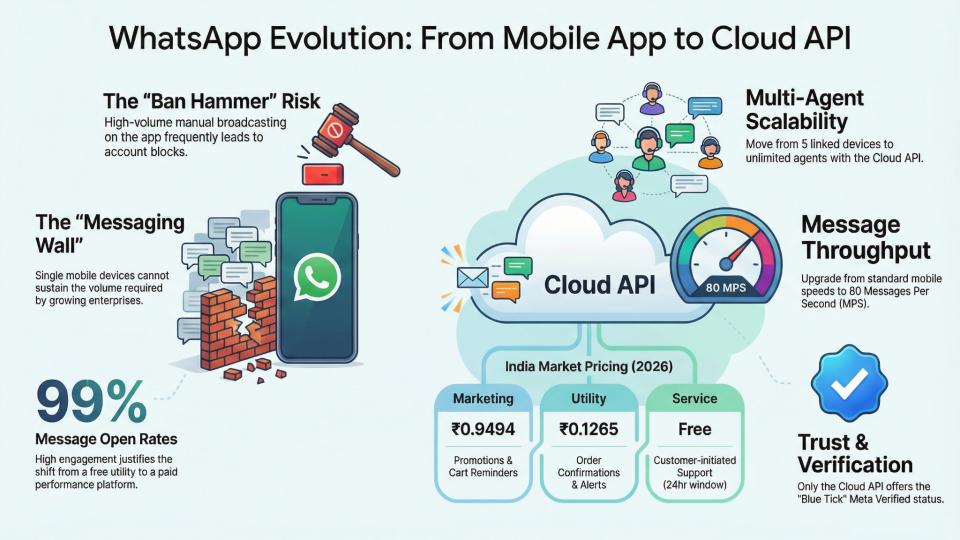
Meta is transitioning from a “conversation-based” model to a “per-template-message” model, effective January 1, 2026. This change aims to simplify budgeting and encourage targeted, high-value messaging.
Chargeable Message Categories
- Marketing: Used for promotions, product launches, and cart reminders. These have the highest rates (e.g., ~0.17 in Germany vs. ~0.013 in India).
- Utility: Used for order confirmations, delivery updates, and payment reminders.
- Authentication: Used for one-time passcodes (OTPs) and security login verifications.
- Service Conversations: Customer-initiated queries. Responses are free if sent within a 24-hour “service window.”
Free Opportunities
- Free Service Window: Replies to customer-initiated messages are free for 24 hours if using free-form text or utility templates.
- Free Entry Points: Conversations starting from “Click-to-WhatsApp” ads or Facebook Page CTA buttons are free for 72 hours.
- Utility Window: Effective July 1, 2025, utility templates sent within an open customer service window are free.
6. WhatsApp Coexistence: Bridging the Gap
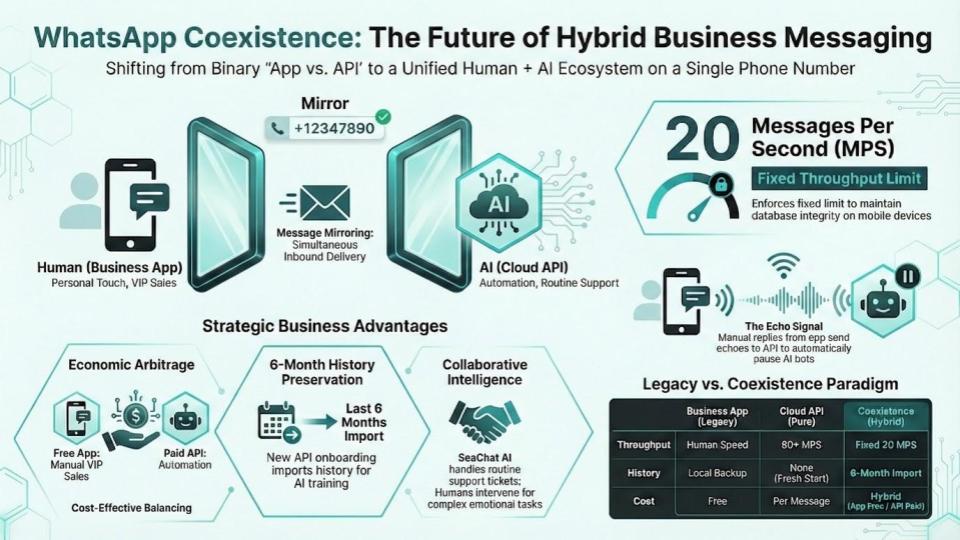
Previously, switching from the App to the API required deleting the App account and losing chat history. WhatsApp Coexistence is a new feature for 2025/2026 that allows both to operate simultaneously.
- Single Number Usage: Businesses can use the same phone number on the Business App and the API.
- Data Syncing: Allows for the synchronization of up to six months of chat history and contacts between the two platforms.
- Functional Split: A business can use the App for personalized 1:1 voice/video calls while using the API for automated bulk broadcasts and CRM-driven notifications.
- Throughput Restriction: Using Coexistence limits the API throughput to 20 messages per second (MPS), compared to the standard 80 MPS for standalone API numbers.
- Regional Limits: Currently unsupported in the UK, EU, and several other countries (e.g., Russia, South Africa, Turkey).
7. Meta Verified: From Green to Blue
Meta is aligning its verification system across Facebook, Instagram, and WhatsApp.
- The Blue Tick: Replacing the previous “Green Tick,” the Blue Tick confirms an account is authentic and recognized by Meta.
- Eligibility: While previously exclusive to the API, the Blue Tick is now becoming available for both the WhatsApp Business App and the Platform through the “Meta Verified for Business” subscription.
- Impact: Verified accounts report higher engagement rates, improved visibility, and higher customer trust in sensitive transactions.
8. Conclusion and Strategic Recommendation
For businesses deciding between these tools in 2026:
- Micro-entities with low volume should remain on the WhatsApp Business App to minimize costs.
- Growing teams requiring better oversight of 5–10 staff members should consider WhatsApp Business Premium.
- Enterprises and high-growth brands must move to the WhatsApp Business Platform (API) to leverage automation, protect data via E2EE, and scale marketing efforts through unlimited broadcasts and CRM integrations.
The introduction of Coexistence provides a low-risk transition path for businesses currently on the App to test API capabilities without losing their existing customer contact history.
Ready to modernize your strategy?