






The Great WhatsApp Divide: 3 Surprising Reasons Your Business Has Outgrown the App
In 2026, WhatsApp has evolved from a simple messaging tool into the primary nervous system of global commerce. For most entrepreneurs, the journey begins with the free WhatsApp Business App (WABA). It is intuitive, familiar, and effective—until it isn’t. There is a specific “moment of friction” every growing enterprise hits: the messaging wall. It’s that point where a single mobile device cannot keep up with the volume of inquiries, and the manual nature of the app begins to throttle your growth.
At this intersection, you face a strategic choice: continue struggling with the limitations of the mobile app or graduate to the WhatsApp Business Platform (Cloud API). Understanding the technical and financial shift between these two paths is the difference between operational stagnation and a high-performance communication stack.
1. The “Grand Sacrifice”—Why Upgrading Means Letting Go
Historically, the transition from the mobile app to the professional Cloud API required a “clean break.” To register a number on the API, Meta traditionally required you to delete the existing account on your mobile app. For many business owners, this is a psychological hurdle; they view their “app” as the bucket holding years of customer trust and context.
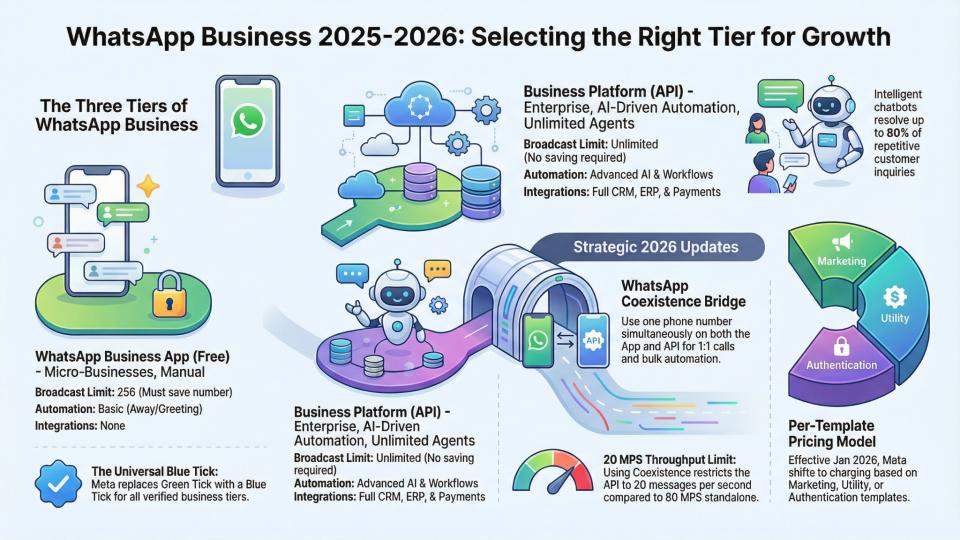
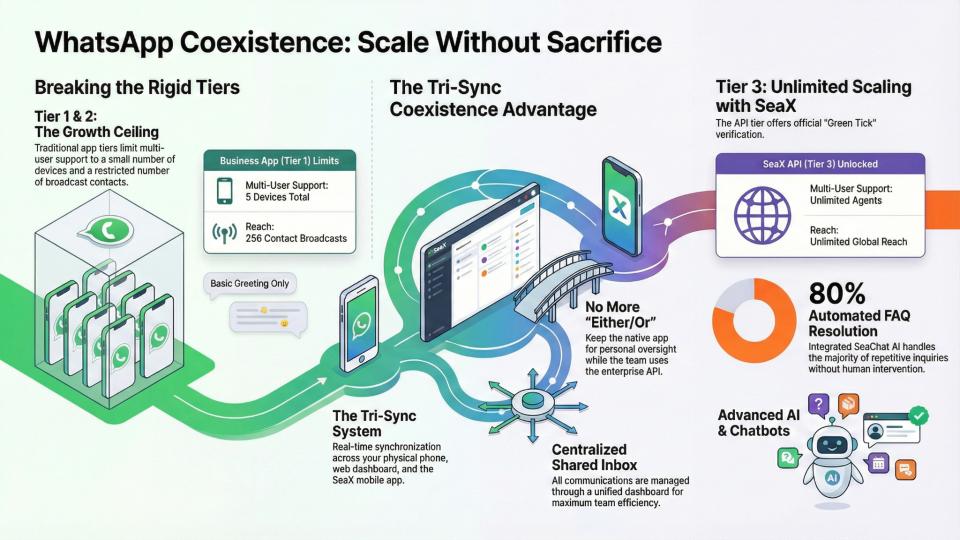
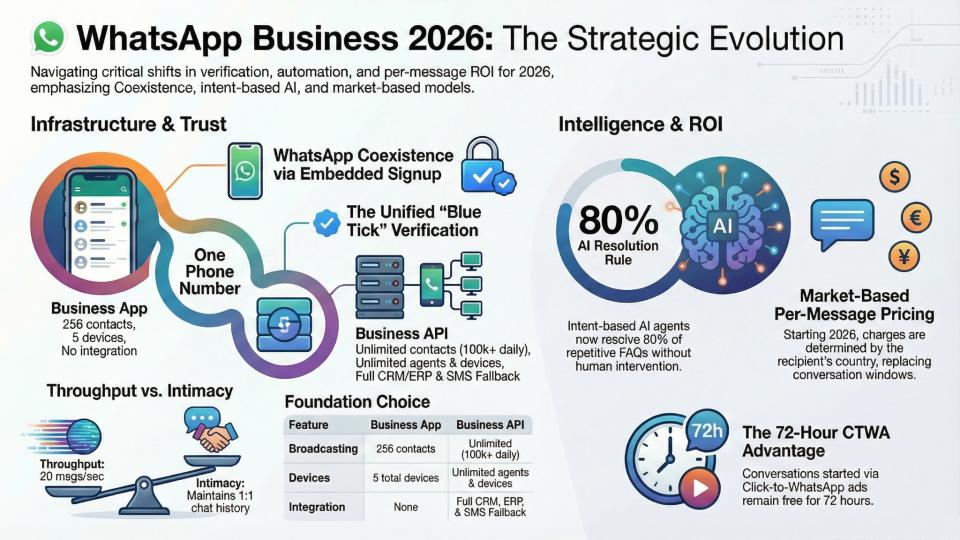
As we look toward 2026, the landscape has shifted with the introduction of “WhatsApp Coexistence.” This feature allows businesses to use the same phone number on both the mobile Business App and the Cloud API simultaneously. While this sounds like a perfect middle ground, it comes with a technical trade-off: your message throughput is capped at a fixed 20 Messages Per Second (MPS), compared to the 80 MPS standard for a direct API integration.
Furthermore, while you can use “Embedded Signups” to sync up to six months of 1:1 conversation history, there is a critical operational caveat: Group Chats do not sync during the transition. For businesses that rely on groups for community management or internal coordination, this remains a significant “sacrifice.”
This can mean that you will lose your entire conversation history and contact lists, leading to building everything from scratch… To resolve this issue, Meta has introduced WhatsApp Coexistence, allowing brands to use their WhatsApp Business app’s phone number and account on the Business API as well.
2. The Cost of Scale—When “Free” Becomes a Business Expense
A common misconception in the SMB space is that WhatsApp is always free. While the Business App costs nothing to download, its lack of automation makes it expensive in terms of human capital. The Cloud API, however, operates on a Destination-Based Billing model. This means your charges are determined by the market (country) of the recipient, not where your business is located.
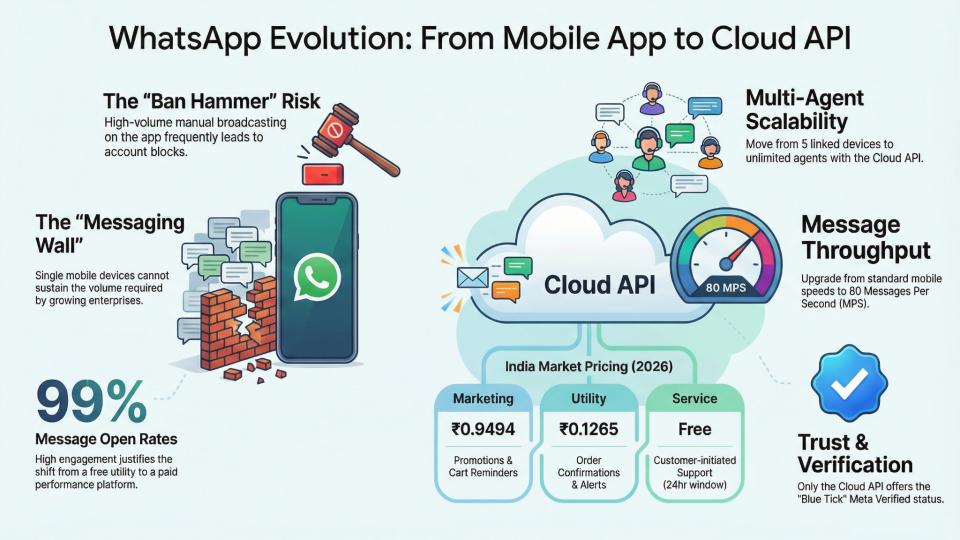
Meta has transitioned to a refined pricing structure effective for 2025/2026. While Service Conversations (user-initiated) are free within a 24-hour window, any Marketing Templates sent within that same window still incur a charge. This ensures that high-value promotional outreach is treated as a strategic investment with measurable ROI, justified by WhatsApp’s staggering 98–99% open rates.
Meta’s 2026 Pricing Categories (India Market Rates):
- Marketing: Promotional outreach and cart reminders (e.g., ₹0.9494 in India).
- Utility: Transactional updates like order confirmations or shipping alerts (e.g., ₹0.1265 in India).
- Authentication: Security-related codes and OTPs (e.g., ₹0.1265 in India).
- Service: Customer-initiated support. These remain free for businesses to respond to within the 24-hour service window.
75% of customers who message a business on platforms like WhatsApp end up making a purchase, justifying the transition from a free utility to a paid performance platform.
3. The Ban Hammer—Why Meta Favors the Platform Over the App
One of the greatest risks to your brand is the “Ban Hammer.” Businesses that attempt to send high-volume broadcasts or automated marketing on the standard app frequently find their numbers blocked. The mobile app is built for manual, personal engagement. The Cloud API, conversely, is the “safe” path because it enforces policy discipline through pre-approved templates and verified opt-ins.
Perhaps most importantly, the API is now the exclusive gateway to the new Blue Tick verification. Moving away from the old Green Tick system, Meta is rolling out Meta Verified for Business. This subscription-based Blue Tick serves as a universal trust signal across the Meta ecosystem, significantly boosting click-through rates and customer confidence.
WABA App vs. Cloud API: Strategic Comparison
| Feature | WhatsApp Business App | WhatsApp Business Platform (API) |
|---|---|---|
| User Limits | 1 Mobile + 4 Linked Devices | Unlimited Agents / Multi-Device |
| Broadcast Limits | 256 Contacts (Static list) | Unlimited (Tier-based scaling) |
| Message Throughput | Standard / Variable | 80 MPS (Standard) / 20 MPS (Coexistence) |
| Automation | Basic Away/Greeting Messages | AI Chatbots, CRM, & TPM Optimization |
| Verification | Not Eligible for OBA | Blue Tick (Meta Verified for Business) |
| Scalability | Single Number / Single Device | Global Multi-Agent / High-Volume |
Implementation Blueprint: Choosing Your Path in 2026
Migrating to a professional platform is an architectural shift that requires working with a Business Solution Provider (BSP). To successfully transition, you must secure these foundational pre-requisites:
- Verified Meta Business Manager: You must provide valid business registration to pass Meta’s compliance audit.
- Unique Phone Number: A dedicated number that can receive an OTP but is not tied to a personal account (unless opting for Coexistence).
- Financial Infrastructure: Meta and your BSP will require a Line of Credit or a Prepaid Wallet to handle destination-based fees without service interruption.
Choose the WhatsApp Business App if:
- You are a freelancer or micro-business handling low daily volumes.
- You manage all chats manually and do not require TPM (Transactions Per Minute) efficiency.
- You do not need to integrate chat data with a CRM like Salesforce or HubSpot.
Choose the WhatsApp Cloud API if:
- You need multiple agents to handle thousands of conversations from a single number.
- You want to automate 80% of FAQs using AI Chatbots.
- You plan to run marketing campaigns that exceed the 256-contact broadcast limit.
- You require the Blue Tick to establish brand authority in a competitive market.
Conclusion: The Future is Conversational
The shift toward “Conversational Commerce” is no longer a luxury for the top 1%; it is a requirement for survival in a 24/7 digital economy. The Cloud API is not merely a messaging tool; it is a scalable growth engine that provides the security, automation, and professional credibility required to compete at an enterprise level.
As you evaluate your strategy for the coming year, ask yourself: Is the comfort of a free app worth the hidden cost of limited reach and manual labor, or are you ready to trade your phone for a platform that scales with your ambition?
Ready to modernize your strategy?